Separate hard constraints from preferences
Begin with resources that cannot be in two places at once: players, match stations, administrators, observers and production positions. Add venue access, accessibility requirements, equipment checks and mandatory breaks. A hard constraint is a condition the plan must respect; a preference is something the team would like to optimise. If those categories are mixed, an apparently efficient schedule can hide an impossible player transfer or an uncovered technical position.
AI assistance is useful for extracting candidate constraints from a production brief, highlighting conflicting entries and explaining why a proposed slot fails. Treat extracted information as a draft. A human planner must check it against the source and confirm which requirements are authoritative. Keep the original statement, its owner and its last confirmation alongside the normalised field. A plausible summary is not evidence that a constraint has been approved.
Estimate ranges and preserve recovery space
Do not train the team to read a predicted finish as a promise. A series in Counter-Strike 2 does not have the same timing structure as a Rocket League match, and format changes can matter as much as the game title. Map vetoes, warm-ups, technical pauses, result confirmation and station resets separately. Historical durations should come from comparable formats and be checked for missing pauses or recording errors.
Use ranges to explore scenarios: an ordinary path, a slower path and a recovery case after an interruption. A model can suggest these scenarios or flag where observed durations diverge from assumptions. It should not silently tighten breaks to make the spreadsheet fit. Protect slack at high-dependency points, particularly before a featured match, a stage change or a venue deadline. The planner should be able to explain what each buffer protects.
Keep one authoritative event state
Platforms such as start.gg, Toornament, Challonge and Battlefy can be part of a competition workflow. Their presence does not establish that a particular integration, export or AI feature is available. Check current documentation, permissions, rate limits and event configuration before designing around a connection. Decide which system owns match readiness and which system owns the released production schedule. Two writable copies with no reconciliation rule create avoidable ambiguity.
Represent timestamps consistently. ISO 8601 provides date-and-time representations, while RFC 3339 defines a commonly used Internet timestamp format. Store an explicit offset or use a consistent UTC representation, then show local times with a clearly labelled time zone. Daylight-saving transitions deserve a deliberate test. A model-generated time-zone conversion should be verified by deterministic date handling, not accepted because the output looks tidy.
Release changes through a named owner
Every published change needs a reason, a version and an approval. The scheduling lead should see the affected matches, broadcast cues, staffing assignments and player communications before release. An assistant can prepare that impact summary, but it must identify its input version and disclose missing data. If the current event state has moved on, reject the proposal or recalculate it rather than editing around a stale recommendation.
Notification is a separate handoff from publication. A changed start time is not operationally complete until the relevant administrator, production position and participant liaison have acknowledged it. Use a short change message: what moved, why, which version applies and who can answer questions. Avoid relying on a long generated explanation in a busy communications channel. The next responsible person needs an actionable instruction, not the model's entire reasoning narrative.
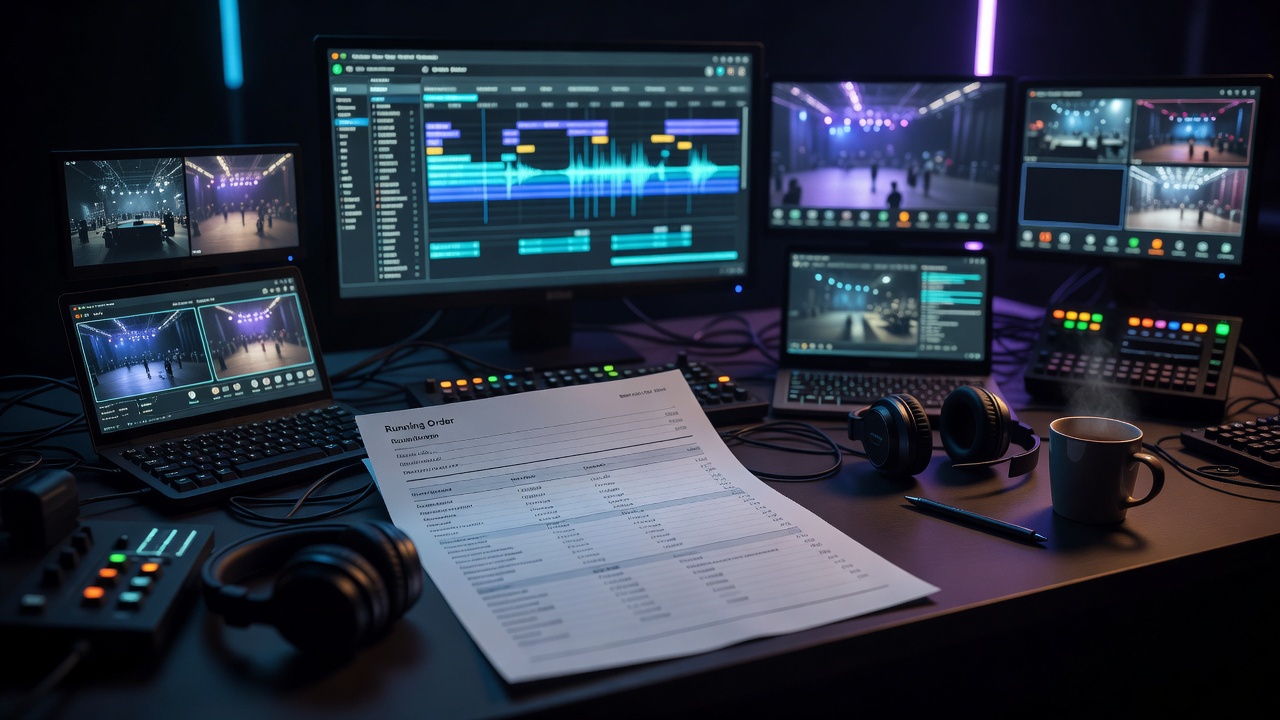
Rehearse the offline running order
Before doors open, export the approved plan into a format the crew can read without the planning service. Include match identifiers, resource assignments, break windows, contact roles and the time of export. Limit personal information to what those recipients need. Store the file where authorised crew can reach it if network access fails, and nominate a person who maintains the manual change log during the interruption.
Test recovery with a concrete exercise: a station fails while a previous series overruns. Can the team freeze speculative changes, identify the latest approved version and continue with a reduced schedule? When service returns, compare the manual log with the system before reopening automated suggestions. The useful measure is not how many recommendations the tool produced, but whether the team preserved a coherent running order under pressure.
| Check | Evidence | Owner |
|---|---|---|
| Resource conflicts | No overlapping exclusive assignments | Scheduling lead |
| Timing assumptions | Format-specific ranges and protected buffers | Competition lead |
| Production impact | Acknowledged cue changes | Producer |
| Offline readiness | Readable, versioned export | Operations lead |
Acceptance criterion: another authorised person can identify the current plan, explain the latest change and continue without the recommendation service.